|
The Trigger Point & Referred Pain Guide brought to you by |
|
The Trigger Point & Referred Pain Guide brought to you by |
|
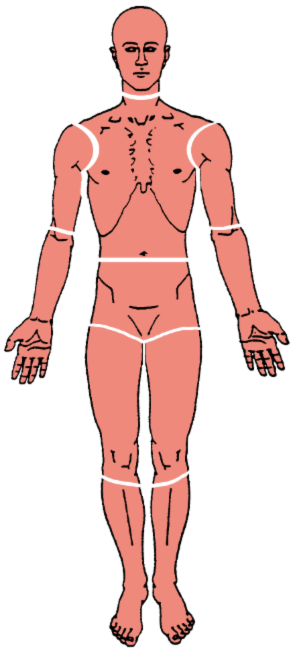
For additional information on trigger points and some very informative articles, visit the MyoRehab trigger point Article Archive. If you are a healthcare provider and would like advanced training for the treatment of myofascial trigger points visit the American Institute for Myofascial Studies or download their seminar series brochure. If you would like to contact us, please send us an email. Keep in mind that an email cannot provide enough information for us to provide a diagnosis or dispense medical advice. Information SourceMost of the information here was adapted from Travell and Simons' Myofascial Pain and Dysfunction: The Trigger Point Manual (2-Volume Set). If you have or treat people with chronic pain it is one of the best resources available. It contains much more than just quality trigger point drawings. It gives specific info (symptoms, related trigger points and treatment) for each muscle. How to use these pages.Begin by choosing the general area of pain from the menu at the left. A figure will be shown that is used to locate the region of pain. Under that regional heading are listed the muscles that may refer pain to that area. Muscles that are likely to refer an essential pain pattern to that area are shown like this: essential pain pattern muscle Regular type identifies the muscles that may refer spillover pattern to that area. The muscle which is a more frequent cause of pain is listed higher. How to read trigger point drawingsThe X represents the trigger point & the red shaded area is the referred pain caused by the trigger point.
To find out if you have a trigger pointA trigger point can often be felt as a lump or can cause a twitch. To see if you have a trigger point push on the suspected spot. If it is a trigger point it will be more tender or sting & the referred pain will increase. |